Fall registration is open, camp is on the floor, and the office work is already done.
A camp week on the floor, a team practice at four thirty, and fall registration open. This is the other work, the work that used to be your evening.
100% free to use, no hidden fees. Members pay about 5% at checkout.
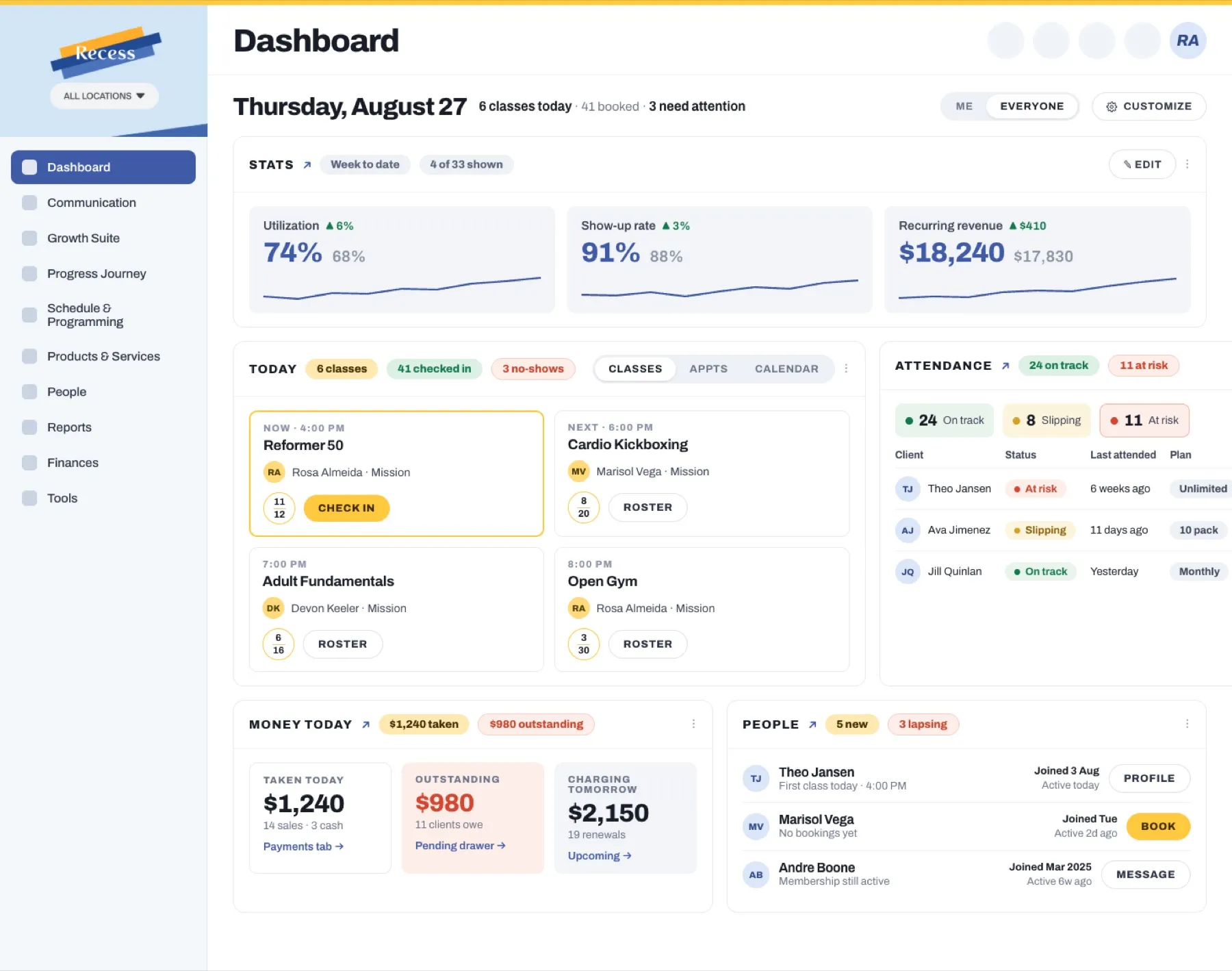
Fall registration opened at midnight, and families enrolled themselves.
You set fall to open at midnight and went to bed. Parents enrolled overnight from their phones, into the season rather than into individual weeks, with tuition billing on the schedule you chose from September through May. Siblings landed on one account with the second-child discount already applied, so nobody at the front desk had to remember it.
Tuesday Level 2 filled at 12:40 in the morning and started a waitlist by itself. That waitlist is not a sticky note. It is an ordered list that offers the next space to the next family automatically, and takes the first yes.
Two cards declined during the run and are already recovering themselves. A surprising share of the families you think quit did not quit. Their card expired in August and nobody noticed until October.
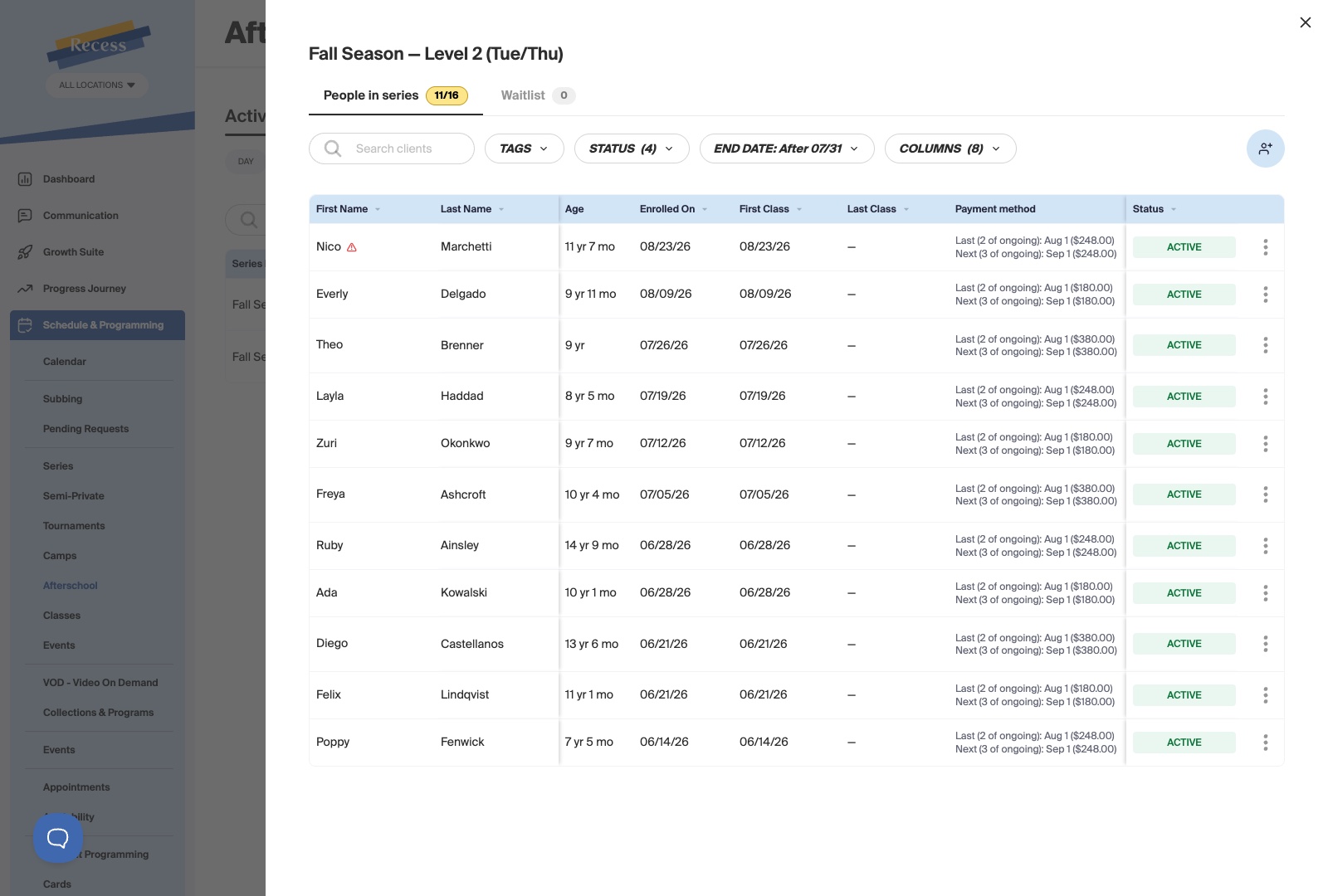
Ninety kids came through the door for camp week five.
Camp check-in ran on the kiosk in the lobby, with a barcode for the families who prefer it and self check-in on a parent's phone once they are at the gym, so the line moved instead of stalling at a clipboard. Half day and full day are separate enrollments at separate prices, and the roster knows which children leave at noon and which stay until four, which matters at 11:55.
Camp is not a class with a different label. It is a program with its own capacity, weekly price, waiver and sibling pricing, and a parent enrolls for the week rather than booking ten sessions. Allergies, medical notes and the emergency contact sit on each child's profile, signed digitally at enrollment.
Because camp sits alongside your classes rather than in a separate tool, a family books it with the card already on file, and your summer revenue is in your reporting without exporting anything.
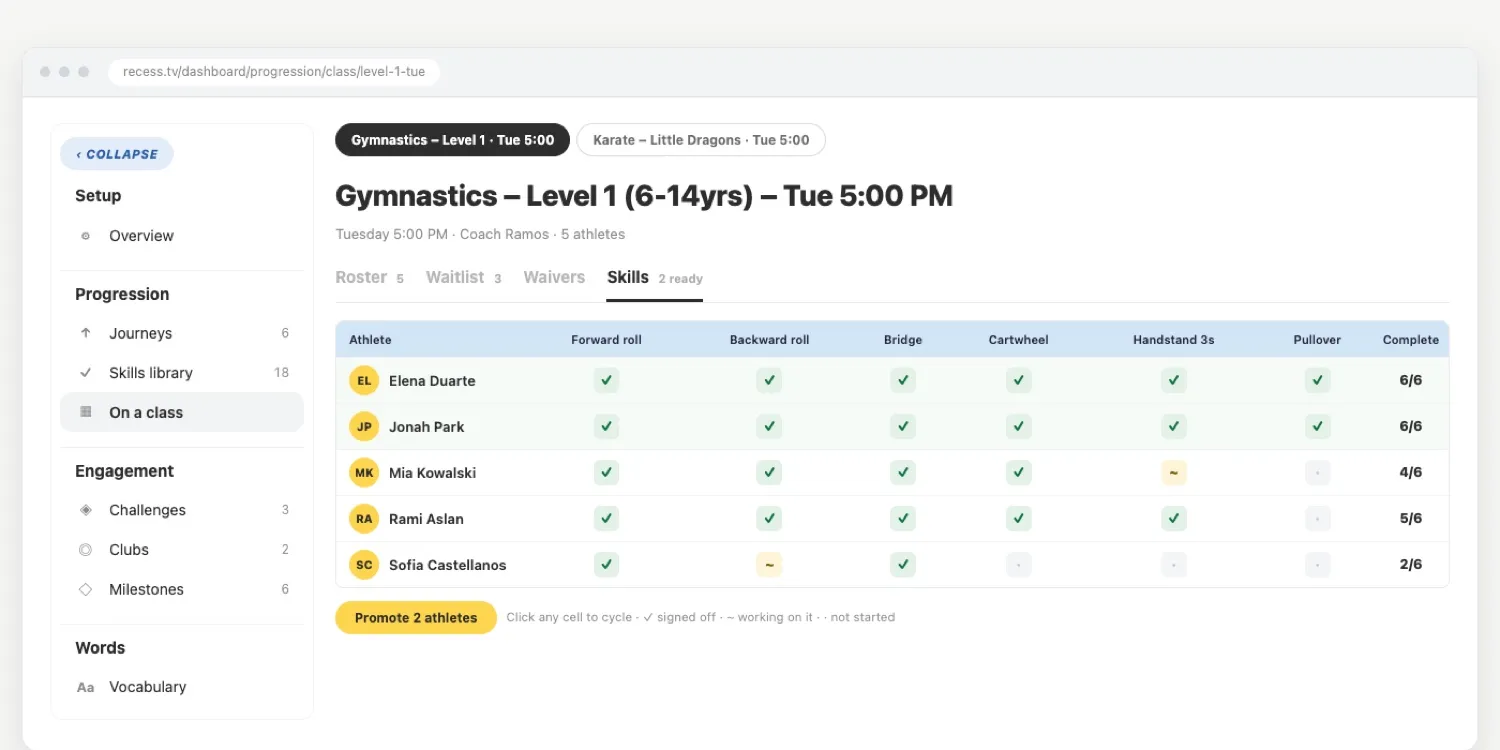
A coach checked off a back handspring at the beam.
She did it on the floor, on a tablet, in the ninety seconds between rotations. That is the whole point. A skill sheet that lives in a binder in the office gets updated in March for the whole year, and by then it is fiction.
Skills and levels are to gymnastics what belts are to a dojo, and Recess treats them as real data instead of a filing problem. You define your own progressions: the levels you run, the skills inside each one, the order they come in, and what a gymnast has to do before she is eligible to move up. Specific skills checked off, class count, time in level, or your judgment as head coach, which stays the final word.
You can see who is eligible for the next level and who is two skills away, so you build a move-up list instead of reconstructing one from memory in August. And the gymnast sees her own progress in your app: a nine year old who knows she is one skill from Level 4 is a nine year old who asks to be at practice.
A parent tried to enroll her daughter in Level 4, and the class was never bookable.
She was on the fall schedule on her phone at lunch, and Level 4 looked like the right day at the right time. Her daughter is a Level 2. Recess did not offer her the class, told her why, and showed her the Level 2 and Level 3 hours that are open.
Nobody at your desk had to explain it, and no coach had to walk a nine year old off the floor on the first Tuesday of the season while her mother watched from the viewing area. That is the whole value of this. The awkward version happens in person, in front of other parents, and it is the reason gyms end up with levels that are not really levels.
You set the gate on the class. It can require a level or a rank, a specific skill a coach has signed off, a prerequisite class, an age range, a tag you keep on the gymnast, or the program the family holds. Use one, or stack several.
A team coach called out for the four thirty optionals practice.
She texted at ten past two. By quarter past, the practice had a coach. Recess texted every other coach qualified to run it, took the first yes, updated the schedule and told the families, so nobody drove across town for a session that was not happening.
Your competitive team and your recreational program are two different businesses sharing a floor, and they stay different in the software. Team practices, meet registrations, travel fees and team-only agreements run as their own programs, with their own rosters and pricing, on top of the same family accounts as your rec classes. A family with one gymnast on team and one in Preschool has one account and one card.
One space in Tuesday Level 3 sold itself twice over.
A gymnast moved up out of Tuesday Level 3, and the space behind her did not sit empty for a month. Recess offered it to the waitlist in order, the first family claimed it, and her tuition prorated to the weeks left in the term rather than charging her for the ones she missed. The roster, the coach's list and the family's balance agree with each other afterward, which is not automatic anywhere else.
Meanwhile a mother who filled in your website form at lunchtime has a trial booked. The lead agent answered her questions about ages and levels, worked out that her six year old belonged in the class that just opened, and put her in it. You will meet her already knowing her daughter's name.
A missed class does not evaporate, either. An absence becomes a make-up credit the parent books into another session at the right level from her phone, without a call to the desk.
By closing time the whole day is already one set of books.
Walk-ins paid at the door on the point of sale, signed the waiver on a phone before they got on the floor, and two of them bought grips on the way out. It went through the same till, onto the same profile and into the same reporting as everything else in the building.
At the end of the night the money is in one place. Business Health connects QuickBooks, so season tuition, camp revenue, open gym, retail, coach payroll and a forward forecast sit together, and you can ask a question about it in plain language instead of building a spreadsheet at eleven at night. Coaches clocked out on the same system that knows their pay rate by class type or head count, so payroll is a report rather than an evening's work.
And the family that stopped coming three weeks ago got a message today, in your gym's voice, from your gym's email domain, without you remembering they existed.

The parent checks her phone on the way home and already knows how it went.
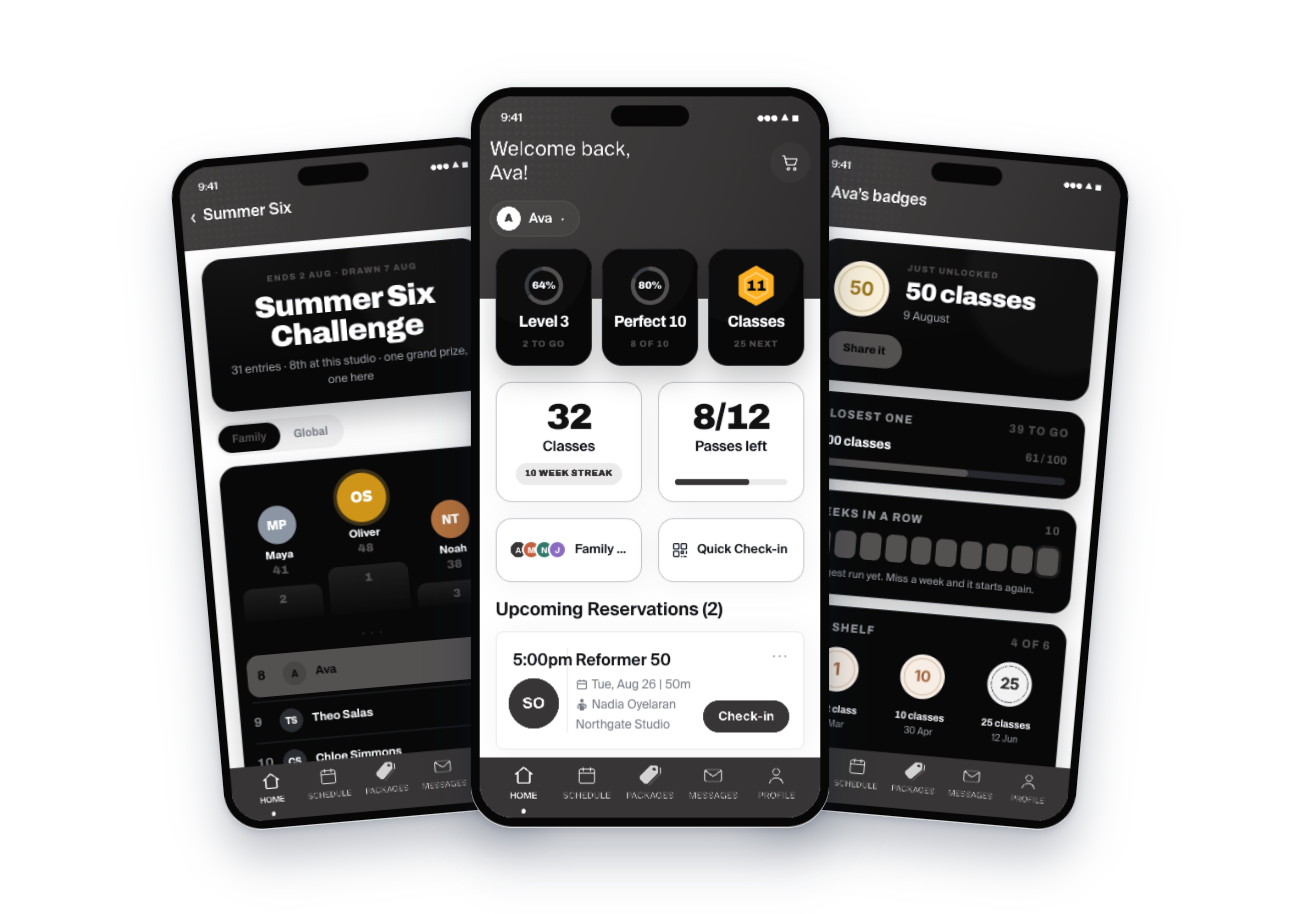
Every gym on Recess gets its own app, carrying your name, your logo and your colors, publishable to the App Store and Google Play under your own listing. Parents are not asked to download something with somebody else's brand on it.
A parent with two gymnasts switches between them in one tap. She can see which skills each of them has signed off, how close they are to the next level, and where they sit in whatever the gym is running that month — without asking a coach at pickup, which is the conversation coaches least want to have while running the next rotation.
She books make-ups, pays, signs forms and updates a card there too. That is the difference between an app people install once and an app people open on a Tuesday night.
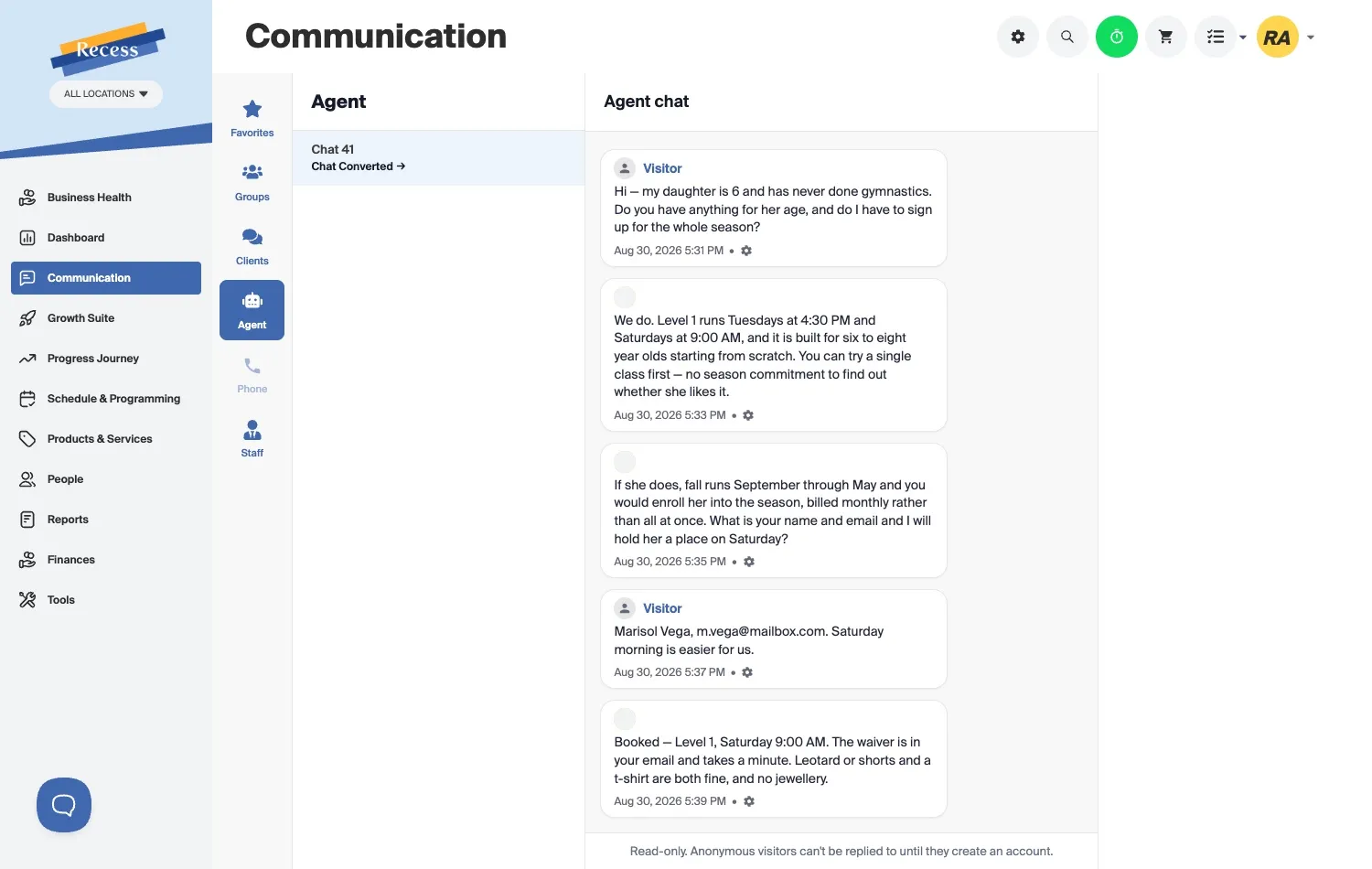
A parent asked about your six-year-old classes at 9pm on a Sunday, and got a real answer.
Most enquiries to a gym arrive after the desk has gone home, and most of them are the same three questions: is there something for my child's age, when does it run, and do I have to commit to the whole season. Every hour one of those sits unanswered is a family deciding to try the gym down the road.
The Recess lead agent answers them in your voice, using your real schedule. It works out which class actually suits the child, takes the parent's name and email, and books the trial — without waking anybody up and without a form that promises a reply within two business days.
You wake up to a booked trial and a conversation you can read back. When the chat converts it becomes a real client thread, so nothing is stranded in a widget somewhere.
Seasons, camps, team and the rest of the office, none of it a paid extra.
There is no plan to choose and nothing behind a paywall, so a gym with sixty gymnasts runs on the same software as one with six hundred.
Why it costs the gym nothing, and who covers it instead.
No monthly platform fee, no per feature add-ons, no setup cost. Recess earns a service fee of about 5% paid by the member at checkout, and card and bank processing is covered by Recess out of that rather than billed to you on top. We only do well when you are collecting money, which is the incentive you want your software to have.
Meet scoring, merchant accounts, and a hundred locations.
If one of these is you, we would rather say so now than six weeks into an onboarding.
What gym owners want answered before registration opens.
Yes. You define the progressions rather than picking from a fixed list, so it works whether you run compulsory levels, your own in-house levels, or skill sheets. You set the order, what makes a gymnast eligible, and what shows on the certificate. Coaches check skills off on a tablet on the floor rather than updating a binder in the office.
Yes, and this is a core case rather than a workaround. The family account holds one payer and several gymnasts, each with their own program, level and attendance. Sibling discounts apply in the right order and recalculate when a child pauses or leaves.
Yes. Camps run as week-long programs with their own capacity, weekly price, waivers and sibling rates, with half day and full day priced separately. Open gym runs through the point of sale with a waiver signed on a phone at the door. Competitive team runs as its own program with meet registration and travel fees, all on the family accounts you already have.
It offers the space to the next family in order and takes the first yes, without anyone at the desk working through a list. Tuition prorates to the weeks left in the term rather than charging for the ones already gone, and the roster, the coach's list and the family's balance agree with each other afterward.
Yes, if you set the gate. A class can require a level, a specific skill a coach has signed off, a prerequisite class, an age range or a tag. The parent is told at the tap, politely, with the classes her daughter can take listed underneath, so no coach has to walk a child off the floor in front of other parents.
Yes. The migration is automated and the Recess team runs it for you. Gymnasts, families, levels, attendance history and billing information come across, so your next season starts with records rather than a blank list. Amilia, PerfectMind and other systems are supported too.
No. Your gym gets its own branded app with your name, logo and colors, published on the App Store and Google Play under your own listing. Parents enroll, pay and sign forms there, and gymnasts see their own progress toward the next level.
It surfaces the drop-off early, because attendance is tracked per gymnast and a child who stops showing up is visible in days rather than at the end of a term. Then it acts, with automated win-back messages sent from your gym's own email domain and recovery of failed payments, which cause more silent departures than most owners expect.